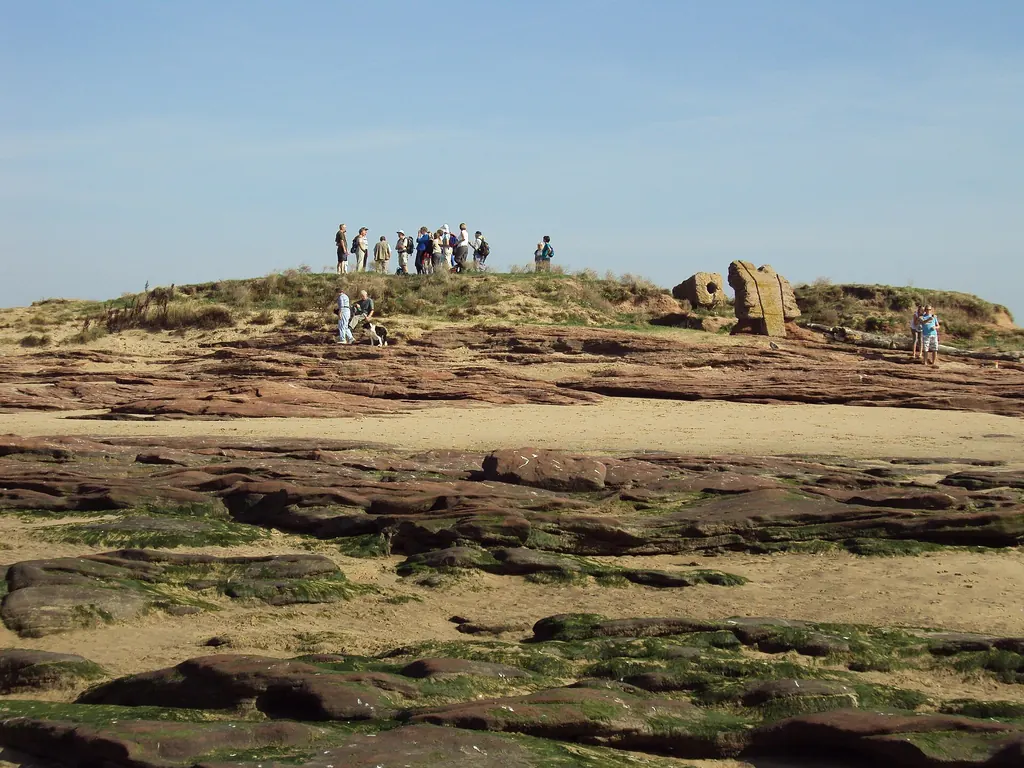
The Gateway
Little Eye
Little Eye, the smallest and first island reached from West Kirby and the first navigation marker on the recognised route: geology, history and wildlife.
Route navigation
The recognised route starts at Dee Lane and heads towards Little Eye before continuing to Middle Eye and Hilbre. Keep Little Eye on your right, and once you pass it turn right across the sand with Middle Eye on your left. Wirral Council puts Little Eye about 1 km from Dee Lane, with a further 1.5 km to the main island. Check the Dee Lane noticeboard and current conditions before setting out.
A changing outcrop
Little Eye is a small sandstone outcrop. The council’s plan gives it as about 6 acres, with a plateau of only about 0.05 acres. Its shape keeps changing: wind-blown sand covers large areas, then high tides wash it away and expose more sandstone. The soil is almost pure blown sand with little humus, so few plants grow there. The council’s plan also says the island has been heavily eroded and reduced in size.
History and archaeology
Little Eye is an important archaeological site. In the 19th century, flints were found washing out of the eroding bank on the beach, among them arrowheads, scrapers and a knife. A small investigation by National Museums Liverpool in 1997 found features with worked flint, shell and charcoal from an early prehistoric hunter-gatherer site. Other records include a leaf-shaped Neolithic arrowhead, a shell midden with mussel shells noted in 1926, and human remains in a hollow in the rock found in 1874, covered by loose stones. Around 1840 a pair of sailing markers replaced earlier wooden ones, one on Little Eye and one on the shore off Hoylake. Sailors lined them up to enter the Hilbre Swash. The markers were demolished in the Second World War, and the base of the Little Eye marker can still be seen.
Wildlife
Together with Middle Eye, Little Eye is a roost for wading birds. They rest here at high water after feeding on the estuary’s mud and sand, and the council says the islands are especially important on high spring tides. The birds are easily disturbed. Keep dogs on a short lead, keep your distance and do not walk through a roosting flock.
Why it matters for the walk
The council notes that dog walkers and runners often treat Little Eye as the destination, an outcrop to aim for rather than the further islands. Little Eye and Middle Eye are cut off before Hilbre, so neither is a place to wait. Plan to be back at Dee Lane within the calculated window and by the calculated leave-by time, not to stay on the sand until the tide arrives.
Related island guides
Visitor guides
Sources
Visitor information checked 20 October 2026.
- Wirral Council: Hilbre Islands Local Nature Reserve visitor information
- RNLI: Staying safe at West Kirby Beach and Hilbre Islands
- Wirral Council: Hilbre Islands Local Nature Reserve Management Plan 2024–2029
- Wirral Council: Hilbre Islands Local Nature Reserve Green Heritage Site Conservation Plan (checked 20 October 2026)