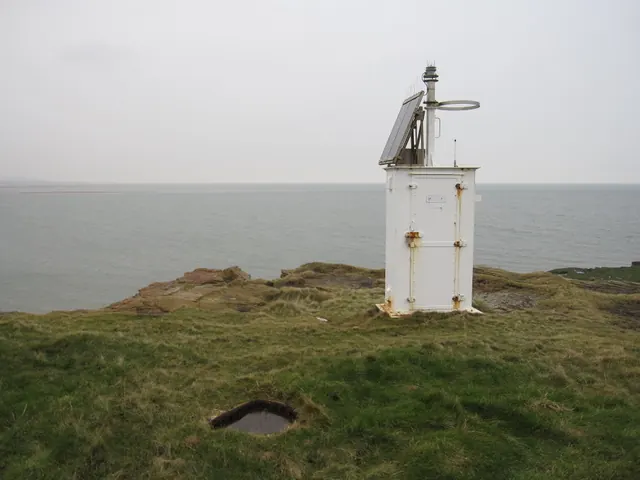
Guardian of the Dee
Hilbre Lighthouse
The white-painted lighthouse is a distinctive landmark on Hilbre Island and part of the Dee Estuary’s navigational infrastructure: how it works and its history.
Operation
Trinity House records the automatic lighthouse as built in 1927 by the Mersey Docks and Harbour Company as a small automatic light. It came under Trinity House jurisdiction in 1973 and was converted from acetylene gas to solar-powered operation in 1995. It is monitored and controlled remotely from the Trinity House planning centre at Harwich in Essex. Trinity House describes the structure as a white steel tower with a red lantern room, now with an LED lantern. The light is a port landmark for the Hilbre Swash, one of the buoyed channels into the Dee Estuary. Its page also carries a “not for navigation purposes” note, and nothing here is navigational advice.
The light
- Established
- 1927
- Power
- Solar
- Characteristic
- Flashing red, once every 3 seconds
- Height of light
- 14 m above mean high water
- Range
- 5 nautical miles
- Location
- Hilbre Island
Earlier navigation marks
The light was not the first aid to navigation on Hilbre. Two tall wooden sailing markers were built at opposite ends of the island around 1810. The footings of the northern one, cut into the bare rock, are often called “monks’ graves” but are the remains of the marker. Wirral Council’s plan says that by about 1840 these were replaced by a pair of markers, one on Little Eye and one on the shore off Hoylake. The area had been an important anchorage until the 19th century, when moving sands made navigation more difficult. Trinity House also had a presence on the island: from late 1837 a buoymaster and his family maintained the buoys around Wirral and the Mersey coast until 1876. The buoys were towed to the island, lifted up the cliff by crane and cleaned, painted and repaired in a store before they went back to sea. The two-storey Buoymaster’s House and store are Grade II listed and part of the Victorian cluster of buildings. The Friends of Hilbre open the Buoymaster’s Workshop museum on their Open Days.
For walkers
The geology is visible below the lighthouse, where the council’s plan photographs layered sandstone. The light helps boats and does not light the walking route. The islands have no lighting, so never cross in darkness or fog, and leave in good time within the calculated window and by the calculated leave-by time. Keep away from the cliff edge.
Related island guides
Visitor guides
Sources
Visitor information checked 20 October 2026.